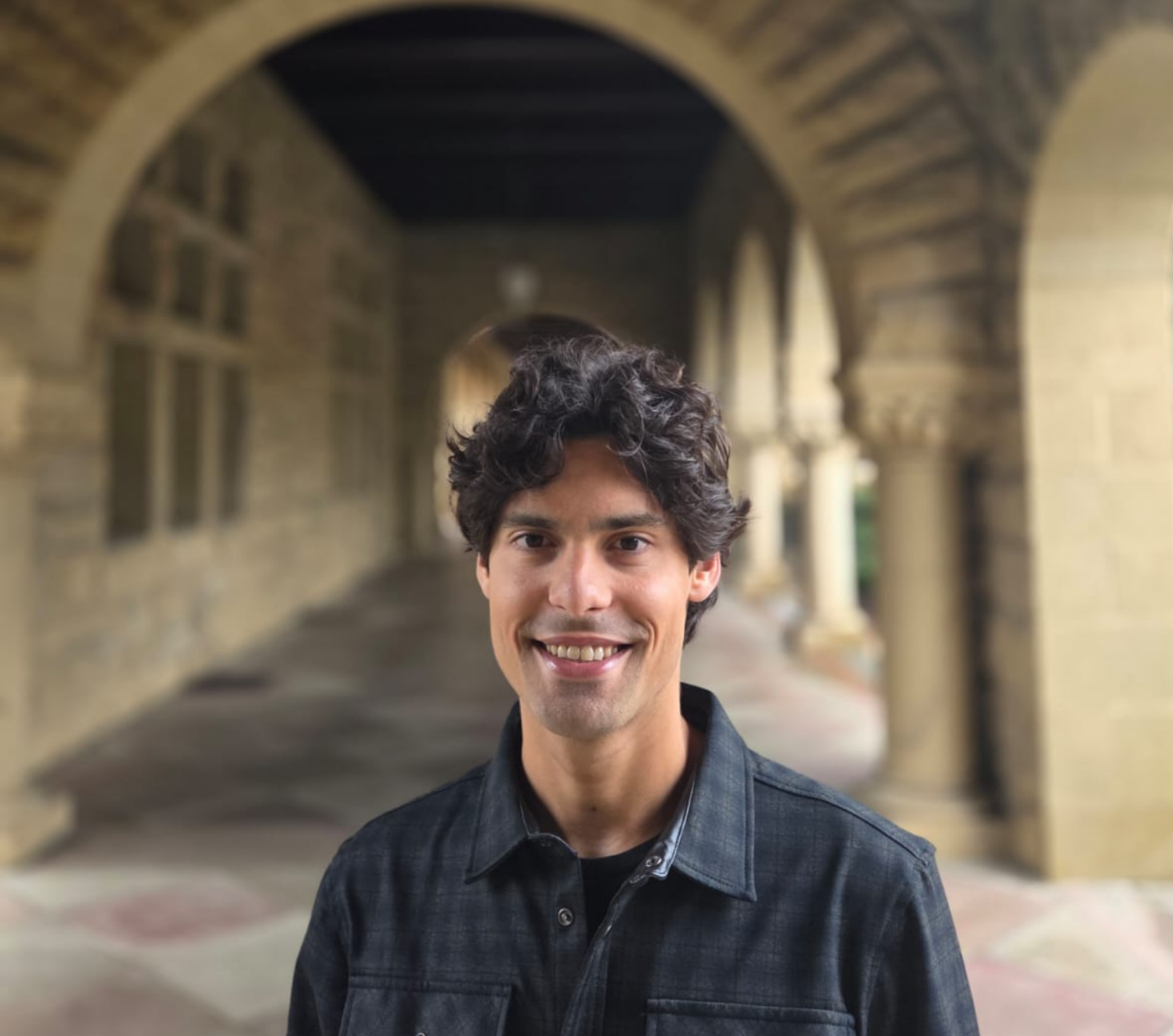
Joao M. Souto-Maior Postdoctoral Scholar
Stanford University CV
Column
Welcome to my website!
I am an educational data scientist who investigates the formation of
unequal learning opportunities across multiple stages of the life course
and how these disparities might be mitigated. My research centers on two
core areas:
within-school inequality: how organizational
decisions contribute to or reduce inequality among students within the
same institution?
learning across the life course: how can adult
learning and training help individuals navigate a rapidly changing labor
market and advance social and economic mobility?
As a quantitative researcher trained in the growing field of
computational social science, I am excited about leveraging new datasets
and methodologies — such as machine learning and agent-based simulations
— to produce rigorous evidence on questions of clear policy concern.
I am currently a Postdoctoral Scholar (New Map of Life Fellow) at the
Stanford Center on
Longevity, where I work on a project led by Professor Mitchell
Stevens aimed at reimagining the existing educational infrastructure to
more effectively integrate learning opportunities across the life
course.
I am originally from São Paulo, Brazil. I hold a Ph.D. in Sociology
of Education from the New York University (2023) and a B.A. in Economics
from the University of Wisconsin-Madison (2017).
Please navigate across the pages to learn about my research,
teaching, and to access selected resources.
Areas of Research
education
inequality
organizations
career
trajectories
life-long
learning
Methods
applied
statistics
social
simulation
Education
Ph.D. Sociology of Education, New York University. 2023.
B.A.
Economics, University of Wisconsin-Madison. 2017.
Research
Column
Peer-reviewed publications
Hoarding without hoarders: opportunity hoarding in the
absence of exclusionary behaviors. Joao Souto-Maior.
2026. Rationality and Society. Abstract: This
paper seeks to clarify the concept of opportunity hoarding as it applies
to Black-White educational inequalities. Two prevailing interpretations
stand out: a group-disparity interpretation, which treats opportunity
hoarding as any process generating group differences, and an
exclusionary-behaviors interpretation, which emphasizes how White actors
secure advantages through exclusionary practices. I argue that the
former is too broad — remaining vague about the underlying mechanisms —
and the latter too narrow, overlooking what I term hoarding without
hoarders, i.e., opportunity hoarding that arises even in the absence of
exclusionary behaviors. I define opportunity hoarding as the relational
processes that generate racial penalties in access to resources, i.e.,
disparities unexplained by previously formed individual differences.
Using an agent-based model of racial disparities in advanced
course-taking, this paper shows how network diffusion — under
segregation, consolidation of race and socioeconomic status, and
temporal constraints — can produce racial penalties even when behaviors
are race-neutral. The framework highlights the need for scholars and
policymakers to look beyond exclusionary acts in the hoarding of
valuable resources.
School racial composition and the emergence of
Black-White within-school inequalities: network-based foundations Joao Souto-Maior. 2025. The Journal of Mathematical
Sociology. Abstract: This
article investigates mechanism-based explanations for a well-known
macro-level pattern in sociology of education, namely, that Black-White
unequal access to advanced coursework is the highest in racially diverse
and majority-White schools. The study proposes that school racial
composition (defined as the share of Whites) could influence the
emergence of Black-White course-taking inequalities through the
combination of two factors: (a), the relevance of network-based
resources for advanced enrollment; and (b), the known relationship
between racial composition and network structure. Through an empirically
informed agent-based model, this study provides support for the proposed
theoretical pathway and shows that, when combined with empirically
representative structural inequalities, this racial composition effect
can help explaining the pattern of interest. Possible policy
implications are discussed.
A critical appraisal of the evidence on racial
disproportionality in special education Rachel Fish, Kenneth
Shores and Joao Souto-Maior. 2025. Exceptional
Children. Abstract: The
under-representation of Black students in special education relative to
White students has been identified by recent research as a key equity
consideration. We provide six quantitative critiques of the extant
literature that should give pause to researchers and policymakers who
have concluded the under-representation in special education for Black
students is a robust quantitative result. These six critiques are: (i)
use of test scores as controls to create non-equivalent comparison
groups, (ii) use of colliders as controls, (iii) overuse of same data
exaggerates robustness, (iv) overused data are not accurate samples of
special education population, (v) over-reliance on regression adjustment
over other matching-type estimators, and (vi) inattention to
generalizability and heterogeneity of special education placement
differences. We identify specific research questions and potential
approaches that are needed before firm conclusions about
under-representation in special education can be reached.
Differences in academic preparedness do not fully
explain Black-White enrollment disparities in advanced high school
coursework Joao Souto-Maior and Ravi Shroff. 2024.
Sociological Science. Abstract: Whether
racial disparities in enrollment in advanced high school coursework can
be attributed to differences in prior academic preparation is a central
question in sociological research and education policy. However,
previous investigations face methodological limitations, for they
compare race-specific enrollment rates of students after adjusting for
characteristics only partially related to their academic preparedness
for advanced coursework. Informed by a recently-developed statistical
technique, we propose and estimate a novel measure of students’ academic
preparedness and use administrative data from a large, urban, public
school system to measure differences in AP mathematics enrollment rates
among similarly prepared students of different races. We find that
preexisting differences in academic preparation do not fully explain the
under-representation of Black students relative to White students in AP
mathematics. Our results imply that achieving equal opportunities for AP
enrollment not only requires equalizing earlier academic experiences,
but also addressing inequities that emerge from coursework placement
processes.
Papers under review
IDEA-aligned estimates of racial disproportionality in
special education versus conventional approaches: a cautionary note on
included-variable bias when achievement and socioeconomic status proxy
for special education need Joao Souto-Maior, Kenneth
Shores and Rachel Fish. Abstract: Whether
selection processes contribute to group-level disparities or merely
reflect pre-existing inequalities is an important societal question. In
the context of observational data, researchers, concerned about
omitted-variable bias, assess selection-contributing inequality via a
kitchen-sink approach, comparing selection outcomes of different-group
individuals net of various characteristics. We introduce a conceptual
framework that clearly defines the quantity of interest and argue that
researchers should only control for the extent to which individuals meet
selection criteria. Informed by this framework, we use directed acyclic
graphs and structural equation modeling to show that traditional
practices can inaccurately represent selection-contributing inequality
because chosen controls frequently capture selection-irrelevant
characteristics, which we define as the correlated proxy problem. Using
Black-White disproportionality in special education as a case study, we
show that typical practices of using test scores as covariates likely
drastically underestimate the influence of selection-contributing
inequality to Black over-representation in special education.
Teaching
Column
Laboratory instructor
Undergraduate basic statistics New York
University — from Spring 2019 to Spring 2021 This introductory
course is designed to prepare undergraduate & master’s level
students to use statistics for data analysis. This course covers
descriptive and inferential statistics; including frequency
distributions, graphs, measures of central tendency, measures of
variability, sampling, probability, z-score, the normal distribution,
and tests of hypothesis such as t-tests, ANOVA, linear correlation and
regression, and chi-squared analysis. Effect size, study designs
(observational and experimental) and research concepts (association and
causation; confounding and interaction) will also be addressed. The
IBM-SPSS software will be used for data analysis.
Column
Teaching assistant
Introduction to US education: historical and
contemporary perspectives New York University — Fall 2022 Throughout the
semester we will look at a number of important issues in contemporary US
schooling through the lens of history. How have these issues developed
over the last three hundred years? What has changed? Who have the prime
change agents been? We will also discuss all of these issues as they are
in schools today. What is happening now? What should happen? What are
the forces for change—for the better or for worse?
For those
who are preparing for careers in teaching, or for students who are
interested in education as a field of study (who may want to be
journalists or researchers or activists in the field), this course
should provide important background historical context. For students of
history or politics or who bring a general interest to the questions of
this course, Introduction to U.S. Education is designed to help us
understand current political, pedagogical, and economic debates.
Political economy of education: why does college cost
so much? New York University — Fall 2022 College in the United
States is expensive, really expensive. For 2022-23, a 120 credit
undergraduate degree costs at least $200,000 at many private elite
universities (like NYU) – plus all sorts of miscellaneous fees, lodging
and food charges, books and more. Why does it cost so much? Is it a good
deal? Why do so many high school students apply to study at such
expensive institutions when there are cheaper alternatives available?
Who is able to attend, and who is excluded? Why do college costs keep
rising so fast? Shouldn’t college be free? The purpose of this course is
to provide answers to these kinds of questions. It will introduce
students to a range of economic concepts and empirical evidence that
speaks to: the value of higher education for individuals and for
societies; federal, state, and institutional financial aid policies;
university budgets and spending priorities. We will consider individual
student, institutional and societal perspectives.
Qualitative methods in international education New York University — Spring 2022 This course provides
an introduction to qualitative methods that scholars and practitioners
use in international and comparative education and the social sciences
more broadly. It is intended to provide an overview of research design,
data collection, and data analysis and presentation most commonly
associated with qualitative research.
Column
Seminar leader
URS seminar: research, creative work and the public
good University of Wisconsin-Madison — 2016-17 The course is
designed to introduce students to the practice of research and creative
work, and its implications for society. The course has two components:
the work you do as an assistant on faculty projects, and your
participation in the small group seminar. In the school year 2016-17,
the seminar is dedicated to the theme: research, creative work and the
public good. We will spend the year critically exploring this theme
across different disciplines, and touching on a range of societal
problems. The theme is to provoke reflection in our research or creative
work experiences, and in the different parts of the world we inhabit.
Come prepared to share your thinking on the topics introduced. Through
discussions, activities and assignments you may learn as much from one
another as you learn through your research project.
URS seminar: research and creative work at the
boundaries University of Wisconsin-Madison — 2015-16 The course is
designed to introduce students to the practice of research and creative
work, and its implications for society. The course has two components:
the work you do as an assistant on faculty projects, and your
participation in the small group seminar. In the school year 2015-16,
the seminar is dedicated to the theme: research and creative work at the
boundaries. We will spend the year critically exploring this theme
across different disciplines, and touching on a range of societal
problems. The theme is to provoke reflection in our research or creative
work experiences, and in the different parts of the world we inhabit.
Come prepared to share your thinking on the topics introduced. Through
discussions, activities and assignments you may learn as much from one
another as you learn through your research project.
Resources
Column
PhD study
Dissertation Essays on the dynamics of
Black-White advanced course-taking inequalities The purpose of the project is to
identify and explore the dynamics of the mechanisms generating
Black-White advanced course-taking inequalities within schools. The
project constructs a series of qualitatively-informed agent-based models
which and explore the conditions which foster/hinder the emergence of
these inequalities. Models are empirically calibrated and validated
according to national data from American schools.
Committee members - L’Heureux Lewis-McCoy (Chair)
- Samuel Lucas - Erez Hatna - Ravi Shroff
Coursework Areas of concentration: school
organization; quantitative methods. Chosen courses result
from the required courses for program completion and elective courses
chosen together with the PhD advisor.
Comprehensive oral exam The doctoral
comprehensive examination in the Sociology of Education program is
intended for students to achieve and demonstrate a comprehensive working
knowledge of a large subfield of sociology. We trust that the knowledge
facilitated by the exam will serve our students well as they write their
dissertations and continue into subsequent stages of their careers. The
exam consists of an oral examination in two areas: (1) a list of 18
books and articles that our program considers to be foundational to the
field of Sociology of Education and (2) approximately 32 additional
readings (for a total of approximately 50 readings on the comps list),
both theoretical and empirical, in an area of the student’s
specialization.
Independent study: Black-White within-school
achievement gaps In this independent
study, my goal was to review some of the key explanations for
within-school achievement gaps in the sociology of education literature.
I am particularly interested in texts discussing how school contexts and
school characteristics contribute to or mitigate the production of
academic inequality within schools. My literature review focuses on four
key themes: (1) peer networks, (2) student course taking, (3) teacher
expectations and (4) parental influence.
Column
Tools for interactive visualizations
A dashboard of inequality in Sao Paulo high
schools
Column
New books network (NBN) podcast
Host of new books in education The New Books
Network is the largest book podcast network in the world, reaching
hundreds of thousands of listeners a month and with listeners
downloading well over a million NBN episodes each month. The purpose of
NBN interviews is to allow authors to tell the audience what they found
in their research and what they wrote in their books. It is a wonderful
idea, connecting authors with a large audience worldwide, and advancing
the broad goal of public education.